|
Examples of Our Work Interactive visual
information processing, interactive image retrieval, segmentation .... Example-based
Image Processing ... (link...) Unifying histogram-based image content descriptor for
content-based image retrieval - the CPAM and AI framework
... (link ...) Integrated framework for image
coding, indexing, and
content-based image retrieval ... (link ...) Visual guided browsing and navigation for fast image
retrieval ... (link ...) Fast comprehensive tone mapping for high dynamic range
image visualization ... (link ...) Colorizing black and white photos ... (link ....) Making beautiful pictures, computational
photography ... (link ....) Machine learning, pattern recognition ... (link ...) Image data mining, image and feature co-clustering .... (link ...) |
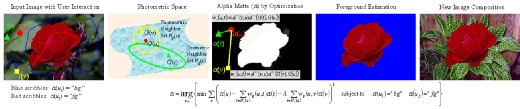 Interactive Image
Segmentation: A user scribbles on the original images indicating
definite background and foreground pixels, which are then used as
constraints to solve a linear quadratic optimisation problem to achieve
good foreground/background segmentation.
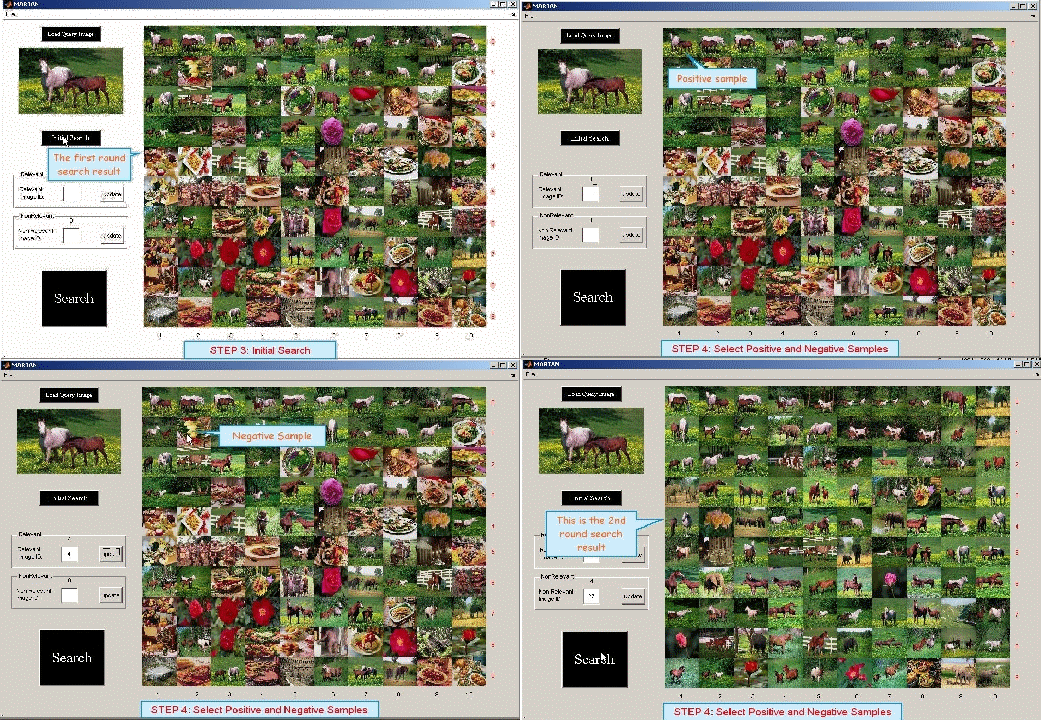 Interactive Image
Retrieval: A user selects positive and negative examples, which are
then used as constraints to solve a linear quadratic optimisation
problem to refine the retrieval result.
|
|
In many machine vision
applications, it is often very difficult or maybe even impossible to
develop fully automatic solutions. For example, despite much research
effort, a fully automatic solution to the longstanding image
segmentation problem is still an unattainable goal. Other examples
where a fully automatic solution is difficult include content-based
image retrieval (CBIR).
Humans have remarkable
abilities in distinguishing different image regions or separating
different classes of objects. Furthermore, users intentions may be
different in different application scenarios. Therefore, good solutions
to many visual information processing problems necessarily require the
incorporation of high level knowledge and human intentions into the
computational algorithms. Interactive approaches, which provide
semi-automatic solutions, put the users in the computational loop and
allow users to supply constraints to the computational algorithms
interactively, may offer a more realistic solution paradigm for many
computer vision problems.
One of the important
challenges to developing successful vision algorithms is to effectively
model high level knowledge and to incorporate the users intentions in
the computational algorithms. We are interested in using
semi-supervised learning to achieve the computational tasks of
interactive visual information processing.
G Qiu, J Guan, "Interactive Image Matting using Optimization", Report-VIPLAB-01-2006 , Visual Information Processing Lab, School of ComputerScience and Information Technology, University of Nottingham, January 2006 (PDF) J. Guan and G. Qiu, "Interactive image segmentation using optimization with statistical priors", International Workshop on The Representation and Use of Prior Knowledge in Vision, In conjunction with ECCV 2006, May 13 2006, Graz, Austria (CDROM Proceedings PDF) J. Guan and G. Qiu, "Interactive Image Matting using Optimization: A Bayesian Network Approach", Proceedings of Pacific Graphics 2006, to appear (PDF) M. Yang, J, Guan, G Qiu, and K-M Lam, "Semi-supervised Learning based on Bayesian Networks and Optimization for Interactive Image Retrieval", BMVC 2006, 17th British Machine Vision Conference, 4-7 September 2006, Edinburgh, to appear (PDF) |